Explain the Different Types of Write Policies of Cache
Direct-mapped fully associative and set-associative. Review the purpose of caching and explore policies for write-through and write-back.
L14 The Memory Hierarchy
Data cache is also known as D-cache.
. You have a more hands-off relationship with L2. 4 cache7 The Principle of Locality The Principle of Locality. In direct mapping the RAM is made use of to store data and.
The mapping is expressed as. There are various types of cache memory based on the types of information it stores. Cache is a type of memory that is used to increase the speed of data access.
If an item is referenced it will tend to be referenced again soon. There are three different policies available for placement of a memory block in the cache. I j modulo m.
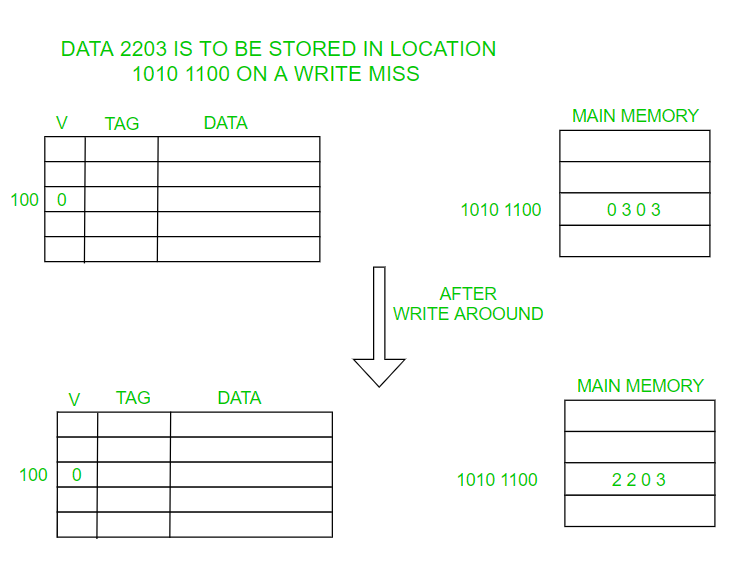
The simplest technique known as direct mapping maps each block of main memory into only one possible cache line. Data cache is used to store only data. If write occurs to a location that is not present in the CacheWrite Miss we use two options Write Allocation and Write Around.
Consider a cache consisting of 128 blocks of 16 words each for total of 2048 2K works and assume that the main memory is addressable by 16 bit address. J main memory block number. This cache is small and its access time is comparable to that of processor registers.
In a fully associative cache every memory location can be cached in any cache line. However it is transferred to the cache memory temporarily if it is used frequently enough. M number of lines in the cache.
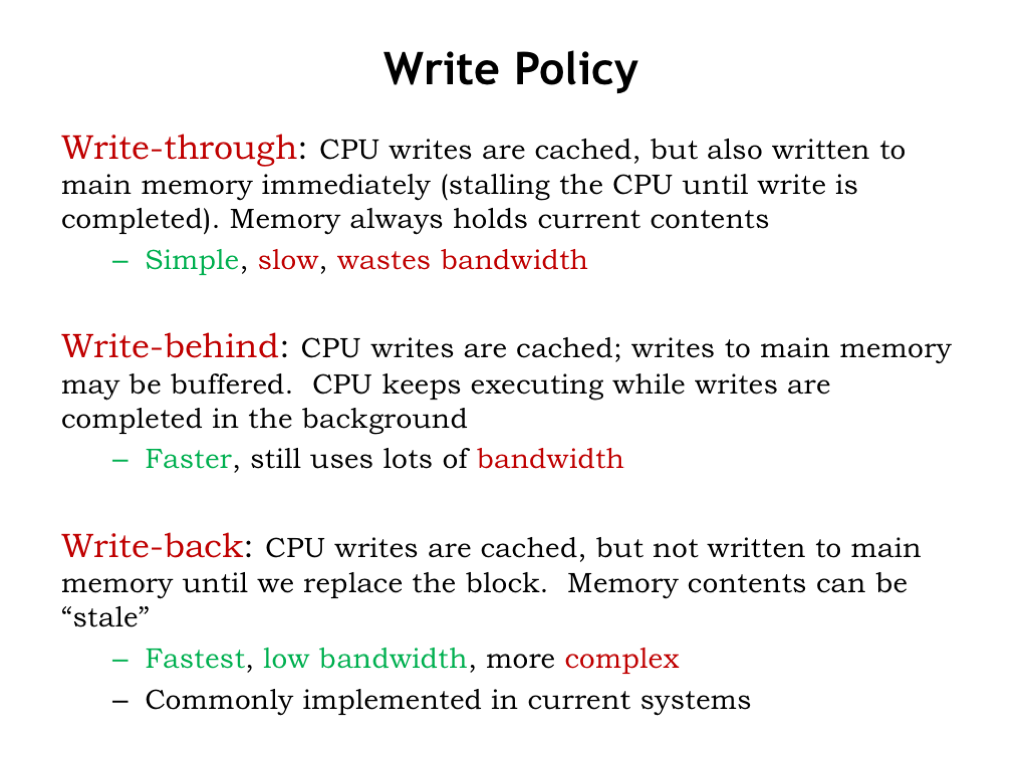
This post explains the three basic cache writing policies. Inconsistency with L2 is intolerable to you. Considered to be the simplest this method involves the updating of the main memory corresponding to every write operation.
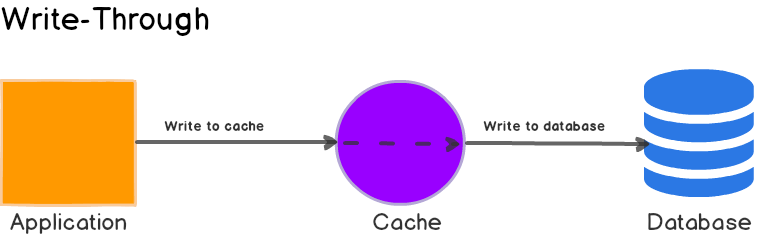
Although caching is not a language-dependent thing well use basic Python code as a way of making the explanation and logic clearer and hopefully easier to understand. In write-through method when the cache memory is updated simultaneously the main memory is also updated. Within that set block j can map to any cache line that is freely available at that moment.
L1 is the primary type cache memory. The different Cache mapping technique are as follows-. RRIP-style policies form the basis for many other cache replacement policies including Hawkeye which won the CRC2 championship and was considered the most advanced cache replacement policy of its time.
You feel uncomfortable when you and L2 disagree about important issues like the data at Address XXX. The process of storing and accessing data from a cache is known as caching. Originally this space of cache organizations was described using the term congruence mapping.
If all the cache lines are occupied then one of the existing blocks will have to be. Unlike instruction fetches and data loads where reducing latency is the prime goal the. Write-through write-around and write-back.
90 of time in 10 of the code Two Different Types of Locality. Besides we can also call it level 2 L2 cache. Spatial Locality Locality in Space.
Write allocation works with both Write back and Write through. This enables the placement of the any word at any place in the cache memory. I cache line number.
In this type of mapping the associative memory is used to store content and addresses both of the memory word. Write hit policies and write miss policies. Temporal Locality Locality in Time.
Running the Python code could also be helpful for simulating and playing around. It is considered to be the fastest and the most flexible mapping form. Program access a relatively small portion of the address space at any instant of time.
Since cache contains 6 lines so number of sets in the cache 6 2 3 sets. Its basic operations are as follows. Figure 1 a shows the mapping for the first m blocks of main memory.
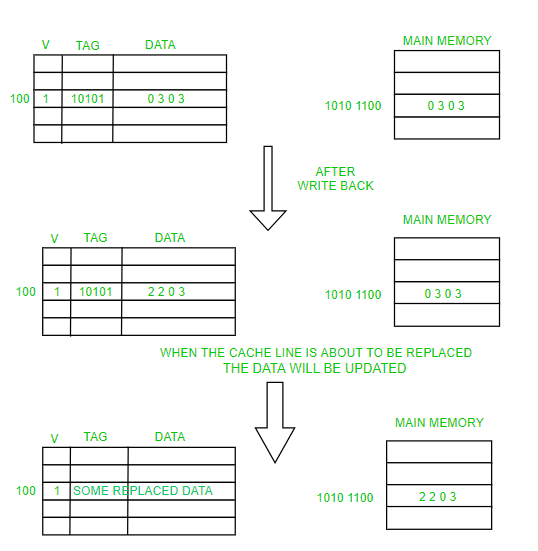
That is if we use the write back policy for write hits then the block is anyway brought to cache write allocate and the dirty bit is set. This memory is present between the primary cache and the main memory. Its located on the processor chip always.
Thus at any given time the main memory contains the same data which is available in the cache memory. Cache memory improves the speed of the CPU but it is expensiveType of Cache Memory is divided into different level that are L1L2L3. Level 1 L1 cache or Primary Cache.
- Write through method. Normally the data required for any process resides in the main memory. Write-around cache is a similar technique to.
Main memory is 64K which will be viewed as 4K blocks of 16 works. This memory type significantly decreases amount of cache-line misses considered as complex type of cache memory implementation. It is referred to as the level 2 L2 cache.
There is three types of cache. To deal with this discomfort you immediately tell L2 about this new version of the data. - Associative mapping.
On the other hand if it is write through policy that is used then the block is not allocated to cache and the modifications happen straight away in main memory. Secondary Cache Secondary cache is placed between the primary cache and the rest of the memory. Different types of cache memory.
Besides its access time is comparable to the processor. You and L2 are soulmates. Write-through policy is the most commonly used methods of writing into the cache memory.
When Cache sizes are large few replacement decisions are sufficient and cache pollution will not be a problem. In Write Allocation data is loaded from the memory into cache and then updated. Write-through cache is good for applications that write and then re-read data frequently as data is stored in cache and results in low read latency.
With this the cache memory is also updated in parallel in case it also contains the. Instruction cache is used to store only instructions. There are two types as follows.
Basic Operations of Cache Memory. 3 Set Associative Mapping. Writes require additional work beyond that for a cache hit eg writing the data back to the memory system.
The cache write policies investigated in this paper fall into two broad categories. - There are two different ways in which cache can be written one is the Write through method and the other is the write back method. Type of Cache memory.
When a write miss occurs we use the write allocate policy or no write allocate policy. The Size of the L1 cache very small comparison to others that is between 2KB to 64KB it depent on computer processor. Instruction cache is also known as I-cache.
Types of Cache Primary Cache A primary cache is always located on the processor chip. Block j of main memory can map to set number j mod 3 only of the cache. Learn about the pros and cons of cache write policies.

Cache Memory Design Geeksforgeeks
Write Through And Write Back In Cache Geeksforgeeks
Caching Strategies And How To Choose The Right One Codeahoy
Write Through And Write Back In Cache Geeksforgeeks


Comments
Post a Comment